EC Land Partners
Partnering With EC Land Partners
Why Not Do It Yourself?
On the surface, dividing land seems simple: hire a surveyor, split the property, and sell it in smaller pieces.
In practice, every decision affects the next one: lot size, frontage, access, road type, drainage, water, county requirements, surveying, engineering, utilities, preserving the ag exemption to avoid rollback taxes, pricing, timing, and what buyers in that market actually want.
Get the combination right and the value created can be substantial. Get one or two variables wrong and the math changes dramatically: tracts that sit on the market for years, carrying costs that eat the margin, thousands of dollars in rollback taxes. An owner who divides his land to make more can end up with much less than if he had sold it whole, after a lot of work.
Because the process is complex, some landowners partner with a developer, someone with a team, capital, and experience subdividing land in the area. That is usually the right call. But two considerations matter.
The first: how is the deal structured? A developer who earns fees from day one gets paid whether the project succeeds or not. A developer who earns only after you’re paid has every reason to make sure it does.
Most developers want to be paid from day one.
We operate differently. You pay nothing for us to develop your land. We agree on a purchase price, and you’re paid that before we earn a dollar of profit. Our books are kept by an independent accountant and are open to you, and we sign a written pledge of accountability and integrity.
The second consideration: does the developer work from instinct or from data? A developer might have fifteen years of experience and successful subdivisions built on gut instinct and local knowledge. But land markets in Texas are shifting faster than ever, and by the time a subdivision is ready to sell, buyers may want something different. One-acre lots might sell quickly in one area and sit for years in another. Luxury ranchettes in an area whose buyers want something modest will sit just as long.
As Texans who grew up on this land, we also work from local instinct, but we combine it with extensive data analysis and demographic forecasting. That is our unique advantage. Before we started EC Land Partners, our managing partner, Mark, built real estate analytics models for institutional investors, including Bain Capital and a private equity real estate firm that managed nearly $1 billion while he was there. He stepped down in 2025 to run EC Land Partners and its sister investment company, Emerging Coast. A subdivision typically reaches the market 12 to 30 months after we start, so we use sales data and migration patterns to plan for the buyers who will be there then, not just the ones who are there today.
How the Partnership Works
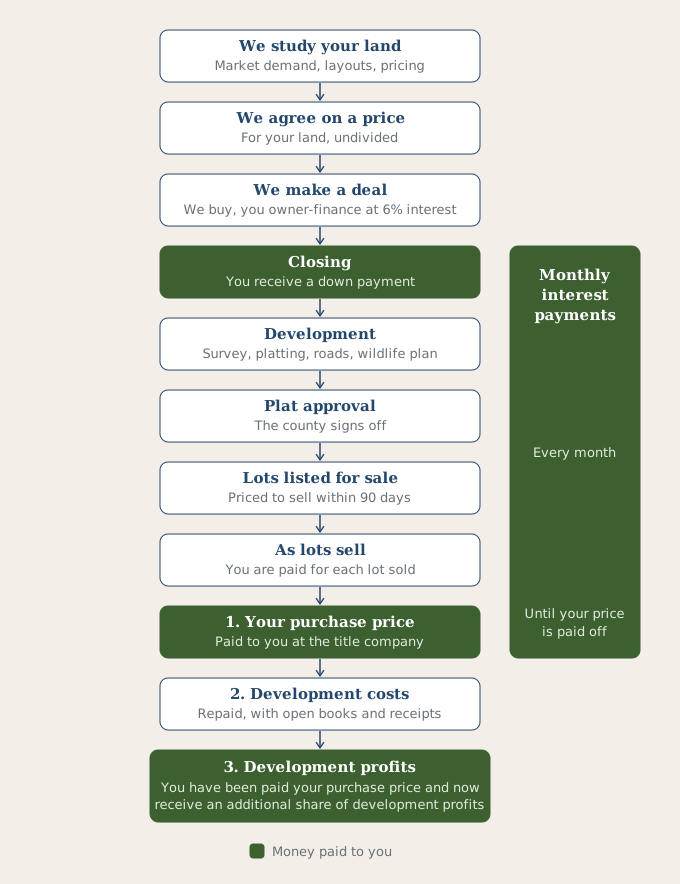
In our most common structure, we buy your land at a fair market price we agree on together. We make a down payment, and you owner-finance the rest. We make a note payment to you every month while we develop the property. As lots sell, the proceeds first pay off the full agreed-upon purchase price of your land. Next, proceeds repay our documented development costs and any rollback taxes. What remains is development profit, and you receive a share of it on top of the full purchase price you’ve already been paid.
What you receive:
- A down payment at closing
- Monthly interest payments until your purchase price is paid off
- The full purchase price for your land as lots sell
- A share of the development profits
Built Around What You Need
Every landowner’s situation is different, so we build each partnership around yours.
- Need cash now? We can put more money down at closing.
- Want a larger share of the upside? That can work if we put less down, at a lower interest rate.
- Want to keep living on your property? We can carve your home out of the deal, or set aside lots in the subdivision for you or your family.
Our Experience
Over the past fifteen years, we’ve bought and sold dozens of properties. We started with urban lots, then moved into rural land. Today we have five active developments in Texas, covering more than 300 acres, with a sixth starting in 2027. Two are closed out, and a third is about to be, with an offer on the table for its final lot. We have directly managed and overseen every one of them.
Mark holds an MBA from Rice with a concentration in real estate. Before EC Land Partners, he held leadership roles at a $1 billion private equity real estate firm, overseeing investment decisions and analytics, and was involved in multimillion-dollar developments. Now he does that same work for the benefit of Texas landowners.
Our Director of Development leads execution, with over 35 years of experience managing real estate developments. After serving as Director of Codes and Development for the City of Seguin, he spent fifteen years at a prominent real estate development and engineering firm in Austin, managing and overseeing the development of hundreds of properties and thousands of lots.
A Bench of Seasoned Professionals Working With Us to Develop Your Property
Every specialist we work with has at least ten years in their field.
- Steubing, our surveying firm, has more than 20 years of operating history.
- Our civil engineer has over 25 years of Texas land development experience.
- We make sure you keep your mineral rights, separate from the surface rights.
- Our land broker is one of the highest-volume land brokers in the state.
- Our CPA specializes in real estate accounting.
Case Study: Kveton Acres, Colorado County
We bought Kveton Acres, 18.95 acres off I-10, in 2021. Our data showed it was priced 15 to 20% below market, largely because a poor listing had led other buyers to pass on it. The data also showed the market wasn’t ready for small tracts yet. So we held the land under its ag exemption, which kept carrying costs low, and waited for demand we knew was coming.
By 2025, the data showed 2- to 9-acre parcels in the corridor selling faster than projected, and we started dividing immediately. Over those four years, the land had appreciated from $208,500 to $450,000, appraised as a single tract.
Instead of a conventional subdivision with county-grade roads, we used Colorado County’s limited land division process and built a 1,100-foot gravel easement road. That saved an estimated $80,000 to $90,000 and a year and a half to two years. Survey to approved plat took about seven months, on a development budget of $35,125.
Down the road, a comparable development spent four years and likely over a million dollars building county-grade roads. Some of its tracts have now been on the market for as long as three years.
On our subdivision, once the plat was approved at seven months, we listed the frontage lots first, priced above target to leave room to negotiate. All five lots drew offers within 30 days of listing. Together they sold for $689,000, $239,000 more than the land was worth whole.
That’s our model. That’s what we do.
Frequently Asked Questions
Let’s Take a Look
If you own land in the Texas Triangle that may be worth more divided than sold whole, email us at partnerships@eclandpartners.com. Tell us about yourself and your property, and we’ll take it from there.
Contact
Get In Touch
Your message goes directly to our personal emails.